The Moscow State Institute of International Relations (MGIMO) is one of Russia’s leading universities. It consistently performs strongly in international rankings: in the 2021 “QS World University Rankings by Subject”, MGIMO was placed among the world’s top 150 universities for “Modern Languages”.
These results reflect both the high quality of MGIMO’s academic training and its distinctive educational approach, which combines rigorous theoretical training with practical skill development. The university supports initiatives aimed at helping students and companies develop their projects. One such initiative is MGIMO Ventures, the university’s startup accelerator programme.
In 2022, during the MGIMO Ventures accelerator programme, VR Supersonic met with MGIMO’s team for educational development and innovation. At the time, we believed VR technology could be applied to foreign language learning. This idea attracted interest within the university, as VR was expected to improve learning outcomes through immersive, practice-oriented experiences.
VR implementation in education
The first demonstration of the VR Supersonic platform took place in Odintsovo on July 7, 2022. MGIMO students and faculty were introduced to the platform, after which they tested English-language VR scenarios and responded positively to the experience.
We see the value of the VR Supersonic platform in the new opportunities it creates to develop our students’ language and communication skills, prepare them for interviews and negotiation scenarios, and enable faculty to create VR scenarios and interdisciplinary courses.
— Elena A. Kozlovskaya, Director of the Odintsovo Branch of MGIMO
Together with the MGIMO team, we identified several challenges affecting the learning outcomes:
- There was a wide variation in students’ language proficiency levels within the groups.
- Students often struggled to master the material, which resulted in unsatisfactory grades and frequent retakes.
- Students who were struggling academically showed lower motivation to study foreign languages.
Pilot project goals:
- improve the quality of language learning, including both general and professionally oriented language training;
- increase students’ academic and behavioural engagement;
- provide faculty members with new opportunities for engagement and professional development.
Pilot project objectives:
- define the implementation approach for the platform and the principles for integration into the educational process;
- develop the content of VR courses and lesson scenarios;
- introduce VR scenarios to pilot student groups;
- assess the impact of the technology on academic performance and engagement while collecting student feedback.
As a result, a pilot VR implementation plan was developed, and the experimental groups were identified.
In August 2022, the preparation phase began. The platform was integrated into the university’s infrastructure, groups of faculty members were formed, and training in the use of VR equipment was provided. Particular attention was paid to developing VR scenarios.
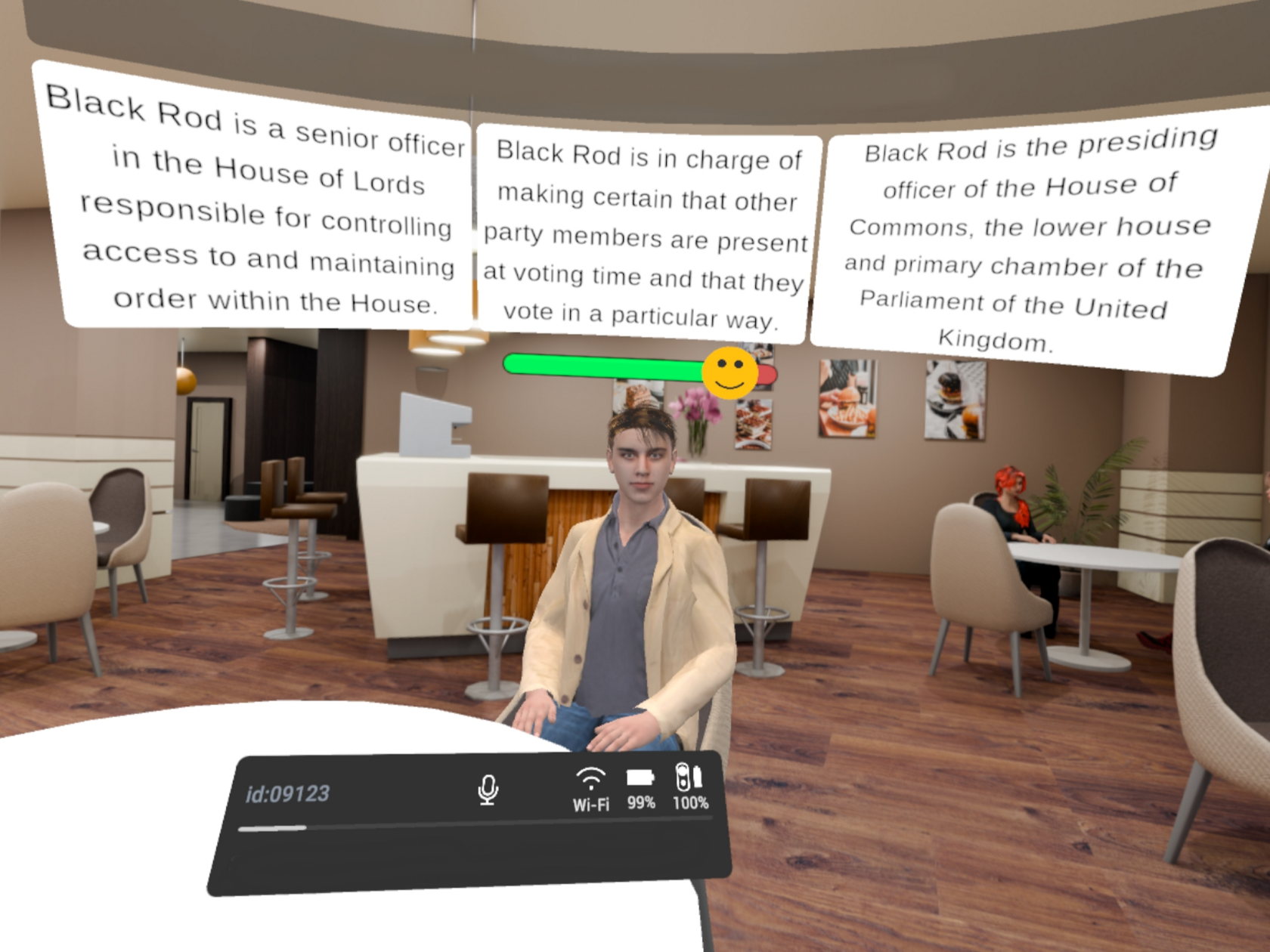
In September, faculty members prepared courses for launch, and in October, the first students began completing VR scenarios. They interacted with virtual interlocutors and discussed the geography and history of the United Kingdom, the personal qualities required for success, and the role of interpersonal relationships in everyday communication.
Pilot results and project rollout
In December 2022, the first results of the pilot were reviewed. The analysis showed improved academic performance among students using VR, while the share of failing grades decreased by almost half. These results supported the further continuation and expansion of the project.
In the following years, the initiative continued to evolve: the number of participating student groups gradually increased, and more faculty members were integrated into the platform.
From 2022 to 2024, more than 250 students from 4 university departments participated in the project. Over the 2-year period, MGIMO reported measurable improvements: student engagement and classroom participation increased, and the share of failing grades declined from 21% to 12%.
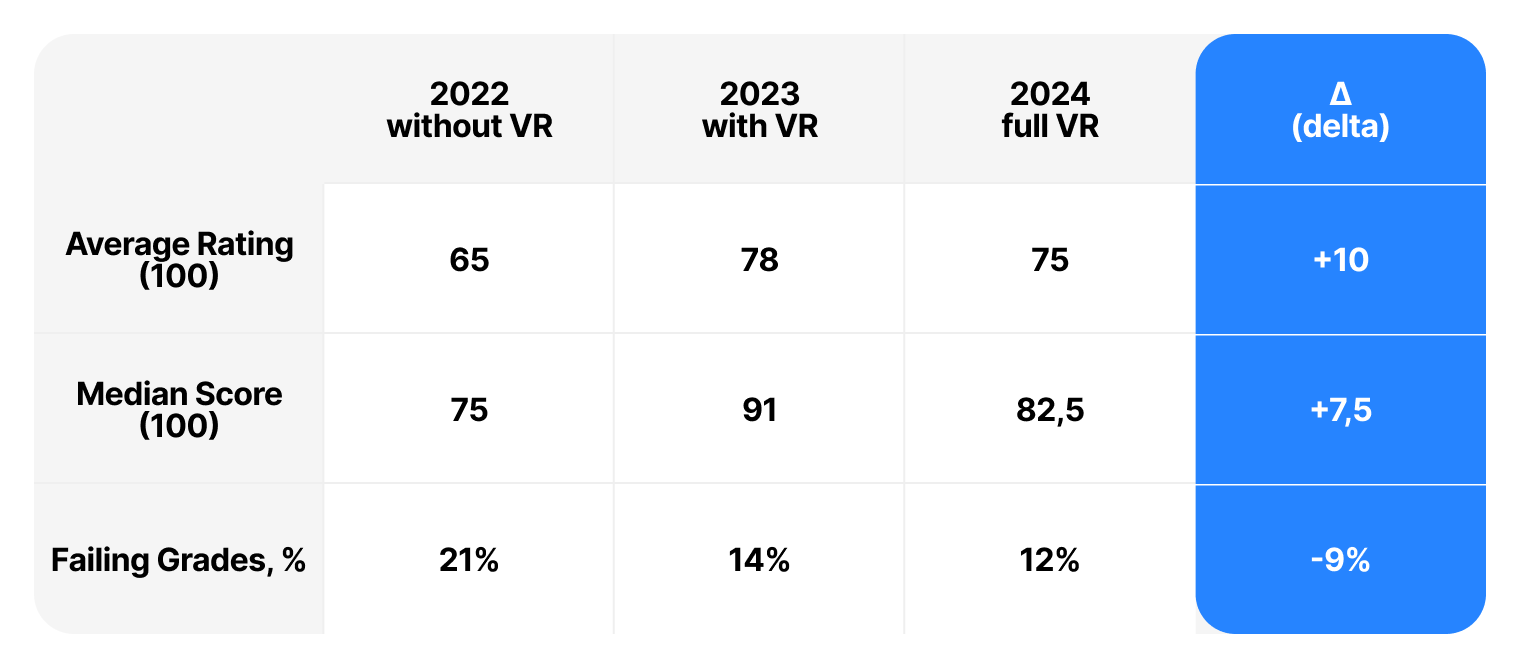
The project also produced stronger academic outcomes. Average assessment scores were 12.5% higher compared to non-VR groups, while course performance ratings increased by 6.5% year over year. Additionally, the VR Supersonic platform reduced the proportion of students struggling with the material by 40% compared to the start of the project.
AI-driven scenarios in education
In the 2024/2025 academic year, a new format of AI-based training scenarios was introduced at MGIMO. Unlike linear VR scenarios with a fixed sequence of events, AI scenarios offer a high degree of flexibility: students are not limited to predefined response options, and the interlocutor’s reaction is based on what the student says. This creates an environment for spontaneous speech practice.
One of the AI scenarios used at MGIMO is called “Debates”. A student enters the simulation, chooses a topic, formulates a position and engages in dialogue with a virtual opponent. The AI then presents counterarguments. Because the scenario unfolds in real time, it encourages students to produce on-the-spot responses in a foreign language. After the simulation, students can review their transcript and receive an assessment based on several criteria: subject knowledge, quality of arguments, coherence, and logical structure.
Head of the Department of Linguistics and Translation & Interpreting Studies, Yulia B. Tsverkun, shared student feedback following the use of the AI scenario “Debates”:
Students noted that they really liked how the bot provides well-reasoned counterarguments and does not allow them to present weak arguments, prevents digressions, and uses advanced vocabulary. <...> Very useful, very effective.
Students also shared their own impressions. A third-year linguistics student commented on completing the “Debates” scenario:
This is not a peer who is ready to support you. The AI asked direct questions, so you had to think carefully about what you were saying. The vocabulary was quite advanced. I even wanted to reuse some of the words the interlocutor said during the debate.
Another student from the same programme added:
It’s great that you can talk to the AI like a real person, and it offers very interesting, relevant arguments. <...> Very useful vocabulary. The language level was advanced but still accessible.
Sometimes faculty members require AI scenarios on a specific topic with particular assessment criteria. In such cases, they submit a detailed brief to the VR Supersonic team, which prepares the prompt and tests it. After the final review, the faculty member assigns the AI scenario to students.
Thus, AI scenarios help both reinforce knowledge gained in lectures and provide additional practice of communicative skills previously developed in linear scenarios.
Results
Today, 662 MGIMO students use the platform for language practice. From 2022 to 2026, they completed 3,224 VR training sessions.
Training is delivered in English, Spanish, Italian, French, German, Chinese, and Arabic. VR scenarios for practising Russian as a foreign language are also planned.
As a result of integrating VR into the MGIMO educational process:
- The gap in language proficiency levels among students has decreased;
- The academic performance of students using VR increased by 12.5% compared to the non-VR group;
- Faculty members reported high attendance rates and active student participation during classroom sessions;
- The time required to reinforce a topic has been reduced threefold: from 60 minutes to only 20.
The MGIMO and VR Supersonic partnership demonstrated that virtual reality and artificial intelligence tools can effectively scale practice-oriented learning. Students gain more opportunities for language practice, explore new communicative situations in a safe environment, and stay engaged throughout the learning process.
The implementation of the project opens up new possibilities for the university. It can expand the range of languages offered, integrate VR into more courses, and create new scenarios that help students develop professionally relevant skills.